The plot? No! Buy. Trust. Read.
The author? Well, now, there's plenty to discuss about Bernhard himself to wet your whistle! So get out that shrill sounding instrument of declaration (?) and read on.
We shall begin with perhaps Bernhard's greatest moment. A speech he gave, described brilliantly in his book My Prizes: An Accounting. If you find yourself obsessed with the beautiful rythmic cadence and musicality of his words, consider a great biography entitled The Making Of An Austrian.
In the coming days you will learn more. As of now, you're all catfish in a lake. They love two things: cheese and blood. He was too much of a true artist to laugh their way through this in a "cheesy" manner. Instead, he preached! He drew and shed blood while taking it all in stride. He and his companion (see: lover 37 years his senior) quickly escaped. Like Chuck Berry: he always got the cash then turned on then all. Righteously so.
He won numerous awards. Big, small, he was an honest hustler: he took the prizes, generally a nice chunk of change, remembered to tell the awarding entity of his disdain for their award and of their ignorance of art, then proceeded to hastily retreat home victorious. His finest moment was perhaps this speech, given when he was awarded the stupidly given Austrian National Book Award in 1967.
Georg Bauer translated this for me. It's beautiful, ugly, crude, refined. It's genius. Truly brilliant; I can only hope that someone, anyone, of Bernhard's "esteem" find the legacy he so rightly is due.
It's said that, when this speech was given in Vienna to a crowd of primarily dignitaries, ministers of this and that, and that obnoxious strata of the social elite (who clearly never read his work), while giving this speech he was booed by most all there. Glass doors into the lobby were slammed and shattered at the hands of government official and the rest. He continued, regarding it all as one would giving a speech to fools. Because he was. But he did it while well dressed, never skipped a beat, then called it a job well done.
Here it is. Enjoy?
"Esteemed Mr. Minister, esteemed assembly, There is nothing to praise, nothing to condemn, nothing to accuse, but a great many things are ludicrous; and everything is ludicrous when one thinks about death. One goes through life impressed, unimpressed, through the scene, everything is exchangeable, in a prop state with better or worse education: what fallacy! One recognizes: a clueless populace, a beautiful country – these are dead or diligently reckless fathers, people with simpleness and perfidy with the poverty of their needs … It is all highly philosophical and unbearable history. The ages are idiotic, the demonic within us a continuous fatherlandish dungeon where elements of stupidity and ruthlessness become daily excretion. The state is a structure which is continually condemned to infamy and imbecility. Life is hopelessness which philosophies lean on, where everything must eventually become insane. We are Austrians, we are apathetic; we are life as common disinterest in life, we are megalomania as future in the process of nature. We have nothing to report, except that we are pathetic, that through our imagination we have lapsed into philosophical-economical-mechanical monotony. Means to an end of downfall, creatures of agony, if everything explains itself to us, we understand nothing. We inhabit a trauma, we are afraid, we have a right to be afraid, we already see, though still indistinct in the background: the giants of fear. What we think is afterthought, what we feel is chaotic, what we are, is unclear. We need not be ashamed, but we are nothing, either, and we deserve nothing but chaos. On behalf of myself and on behalf of all other laureates, I express my gratitude to all who are present."
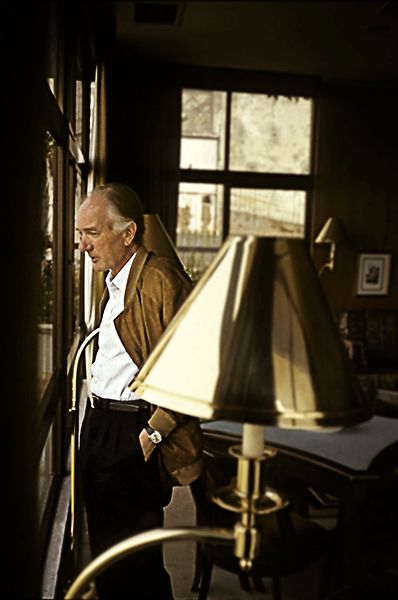
The picture of him included was taken several years later in the home he bought with THIS prize money. I'm impressed!
More to come. Where are YOU in reading the book?
Let's discuss it now. Because The Moviegoer is our next book. Order now'

I have read the first 40 pages of The Loser. Rare that something so insular can also be such a page-turner. Will be reading more today. Thank you for this group and the selection.
ReplyDeleteSingular thing. I went to my local library yesterday morning to look for The Loser, and not only did they not have it, but they had nothing by Thomas Bernhard. Not only that, but no library in the Dublin City Council area anything by Thomas Bernhard that I could get on a branch loan. I'm flabbergast! The kindly librarian ordered it of Amazon for me, since they have a budget for that. But I reckon it'll be two or three weeks before I'll get my kits on it, at the earliest, by which time I'll have missed the johprah bus. A trip to a bookshop is in order. But they'll probably have to order it and I'll be in for a wait as well. Oh well, at least I got Tom Bernhard into Dublin Libraries.
ReplyDeleteSara: Wow. If I possessed the ability to be that succinct, that's precisely how I'd describe reading him when he's at his best. It's so very specific in the manner in which it's personal (Bernhard lost the ability to sing and was a musician before a writer) and almost claustrophobic at times. There's a genuineness and a fragility that balance out what would be called "bitterness" in most others because he is so capable of creating entrancing passages that don't "feel" bitter, but, to me they are more indignant and righteously angry or they are like statements of acceptance and resignation to reality. He barely avoids misanthropy because he so clearly loved life and, despite himself, humanity. It's the internal conflict in him that shines through and is so thinly veiled that makes him one of my favorites. He's utterly vulnerable and somehow, though filled with doubt, he was filled even more so with a deep need to connect with others and to do so as he truly was, as his genuine self. Quite admirable given circumstances. I agree: it's like an interior monologue page-turner. How can that be?!? Glad you're into it, Sara! Thanks for the insight!!
ReplyDeleteThanks! The narrator's vulnerability and humanity come through and keep the reader not aloft but engaged. His path is rough the love of a life and an art that dismayed and betrayed. Stunning book and so glad I am reading it.
DeleteDesmond: Sadly, I'm not surprised at all. You won't have missed the bus, though. It just started running. Everyone is going to find the same difficulties. Barnes and Noble carries a couple of his works occasionally here, but he's basically lauded by critics and remains unknown. I suppose that's why I started this series and why I mentioned the next book now. Percy is criminally ignored, too. In lieu of asking y'all to read anything obvious, it's my hope that this can be a book club that illuminates works that deserve an audience and authors who I have come to know of but know others would never learn of unless they were lucky and got the recommendation from a friend. I truly hope this can become a place that showcases the overly simplified view our society has created about what's worthwhile and what isn't. Our society also loves to ignore the great and righteous provocateurs as they are feared by the powerful within it. Another reason why they may carry so little in Ireland is because he railed against the Austrian government's relationship with the Vatican and would appear to be almost anti-Catholic. He's anti-church and state relationships. Not specifically Catholicism but any religious indoctrination done by or allowed by the government. His government at the time was much like many Irish friends have described their childhood memories. I'm Catholic. I agree with him. But governments and their libraries might not in places where the relationship between the church and the state has before and still does exist. When I read that he was "anti-Catholic" on sites that biograph him, I always get a bit angry. It's not that simple and anyone who would write that clearly didn't read him. All the more reason to not give up! I look forward to hearing your thoughts!
ReplyDeleteI ordered off Amazon from England yesterday. It'll probably still take at least a week to get here.
DeleteJohn: your explanations of why Bernhard might not be stocked in Dublin libraries is interesting - a subtle form of censorship, if true. Although these days it's far more fashionable to be anti-Catholic, and anti-Church/State collusion. (The Vatican's representative in Ireland was actually withdrawn some time ago, after the Taoiseach (Prime Minister) criticised the Vatican's handling of child abuse complaints.) I wonder is Bernhard taught in the German (Austrian?) Departments of Our Great Universities?
DeleteDesmond, this is going to be an interesting debate we have with ourselves once I explain.... I know what you mean about Ireland today. But the wheels were in motion. Hence the "moment of silence" on RTE everyday. Not Catholic but still there, agreed? It's "nice", but does it remind you of religion? Even unconsciously? Still, what's "bad" about a moment of silence, right? I likely have thought farer toooo much about Ireland and Irish politics..... For instance: the Vatican has a representative in Ireland. That type of representation would be feared or tossed off here. Kennedy was considered unelectable because he was Catholic. Until he was elected... What you are alluding to is PRECISELY what Bernhard fought against. It's a paradox. A strange one. I'll explain soon, but DAMN! You caught it quick, bud!
DeleteIt came in the mail yesterday. I hope to finish the book that I'm reading this weekend and start this soon after.
ReplyDeleteWhat are you currently reading, Bill?
ReplyDeleteMainlines, Blood Feasts, and Bad Taste - A Lester Bangs Reader. Its my first exposure to his writing and I'd say its worth a read. Most of the essays are at least somewhat entertaining and amusing. I have about 60 pages left which I should be able to finish at some point during the weekend.
DeleteLove Lester!!!
DeleteCan I start giving my excuses now? I was no good at deadlines at school and now I've got the added distraction of a three year old.
ReplyDeleteBut I read the first 10 pages at work when the book arrived (shh, don't tell the boss) and I'm intrigued already.
You'll read it. And: no.
DeleteAlso, Faber Finds seems to be the place to get it new, in the UK at least.
ReplyDeleteFeeling like I must comment to the group, having already provided a bit of private feedback to JohP. The intial feedback I gave after 20 pages was, no, I'm not selling my damn piano (or something similar if not more profane). After 50 pages, the sickening feeling, realization, that it has happened already, and can't undo. Yep, this is hitting home.
ReplyDeleteHey there , just a quickie to say Im going to be joining y'all, but that the book wont arrive for 2 or 3 weeks . Luckily I read fast as Im also an ex addict (booze and whatever else ) always starving for a fix of Beauty and Truth .
ReplyDeleteI ordered the next book upfront so as to have my shit together for the next session .
Will write y'all again in a few weeks , keep following the way of Grace , Treya
Just finished reading the book. Found it difficult at first, confused by the repetition, the lack of paragraphs, but soon got caught up and found it difficult to put down. his thoughts race and contradict, repeat and repeat, there were moments when i was going backwards and forwards to catch a thread, his will I won't I ask the innkeeper about her uncle for example. Some grim humour, the idea of a suicide thirty years in the making, determined by one remark. Behind it all a stark view of the human race. I've held off from reading more about Bernhard until I finished the book but the afterword does sketch him in. I thought it was interesting and ironic that Kurt Waldheim, of all people, denounced his vision of Austria. I need to go back to the bookmarks and read again. I think there is a degree of misanthropy here with everyone doomed from birth so it seems. However there do appear to be some shafts of light particularly when he's discussing music.
ReplyDeleteJust a quick comment as I pass by but I just hit the halfway point of the book and POW, it's clicked. I've got a few sections to quote and explanations to attempt but I don't have the book to hand right now.
ReplyDeleteI'll be back.
It took me a while to get the book (in both senses!) but I’m over half way through now and totally absorbed. To start with I found the fact that you had recommended it distracting – I was thinking about what it was that meant so much to you, rather than just thinking about what I thought of it. For instance when he said, ‘We study better in hostile surroundings than in hospitable ones, a student is always advised to choose a hostile place of study than a hospitable one, for the hospitable one will rob him of the better part of his concentration . . . the hostile place on the other hand will allow him total concentration since he must concentrate on his studies to avoid despairing’, I thought his Salzburg was your California.
ReplyDeleteThen, once I’d got over thinking about you, I found the constant repetition of ‘he said, I thought’ very irritating – it felt like trying to listen to someone playing a beautiful piece of music on the piano but there’s one key out of tune. And I became tense knowing that ‘note’ was going to keep being hit and I’d be waiting for the bum note and not truly hearing the rest of the music. But it also made me think of the repetition you find in prayer or the rosary.
Then suddenly, nearly half way through the book, I found myself being struck time and time again by wonderful nuggets of wisdom and thought-provoking phrases that I had to bookmark. I love the fable of the ash tree that Glenn cuts it down because he feels it’s obstructing his playing but only afterwards he realises he could just have drawn the curtains: ‘We often cut down such an ash, a whole forest of such mental ashes, he said, and we could have spared ourselves the work with a simple sleight of hand’.
Do artist aspire to actually be the instrument? The Steinway in this case. I found the idea of the musician hating being between the composer (Bach) and the piano and therefore wanting to be the Steinway itself intriguing. It sounds spiritual. It made me think of Glenn’s playing as a form of meditation, striving to achieve a higher state of consciousness, beyond mind and body.
The book can seem quite downbeat, but there’s a succinct pointer towards survival that struck a chord for me: ‘Wertheimer wasn’t capable of seeing himself as a unique and autonomous being, as people can and must if they don’t want to despair, no matter what kind of person, one is always a unique and autonomous being, I say to myself over and over, and am rescued’.
I have to say I'm finding it difficult to get into this book. Stopped reading Cormac McCarthy's Blood Meridian to read it and the contrast in styles is quite a clash. After reading some of the comments above though I'll stick at it and hope for enlightenment.
ReplyDeletePlease don't stop reading Blood Meridian...for anything!
DeleteI'm in agreement with Jane.... Get back to Cormac! We will see you soon!
DeleteThe Loser arrived in the post yesterday morning. I read the first twenty-five pages in bed this morning. He's like a more refined Houellebecq, isn't he? There is considerable comedy in his hyperbolic generalisations. The influence of Beckett will also be detected. Loving it so far. It should really be read at one sitting. Oh, those cretinous Salzbergers, those cretinous piano virtuosos.
ReplyDeleteSo...book in hand and late at night, here are my halfway point thoughts...
ReplyDeleteI wish I had the spare time to read this in one go but unfortunately work and a young child preclude it!
Whilst there is an initially downbeat feeling created by the apparent misanthropy of the narrator and Gould and Wertheimer, I think deeper reading reveals a hope in the writing and that a lot of the 'negative' feeling is provided by the characters' great need for perfection and truth in their art 'For we always think we are authentic and in truth we are not, we think we're intense and in truth are not.'
I've taken a lot of it as a satire on people's and society's need to conform whilst telling ourselves we're unique and a reluctance to face reality and real truth 'Again and again we try to escape ourselves, but we fail in our efforts, constantly run our heads into the wall because we don't want to recognize that we can't escape ourselves, except in death'
Wertheimer's suicide as a way of finally asserting himself in life is a shocking but, I suspect, common act.
Stylistically, I think once you're used to the repetition and have settled into reading it it's very effective at communicating the looping thought processes most people have as they analyse whilst talking.
Can't wait to finish it. In fact, I was torn as to whether I should spend ten minutes writing this or reading more of the book. Not least because it seems a little silly to examine a book before finishing it but I figure it's interesting to see if people's thoughts on the book change as they go.
First off: y'all are amazing! Thanks for indulging me, then showing me it was a worthwhile indulgence. Secretly, I wanted to be a professor. I wanted to be that nutty one that wears tweed in Summer and says something ridiculously heavy and true in between disassociated ramblings. I quickly realized, after reading all of your comments and starting this book club, that I sort of AM that.... Just the songwriting version without the wardrobe or chalkboard or horrible but steady paycheck... I've been working out how to respond to your comments. They cut straight to the point! I wasn't expecting that....
ReplyDeleteIs Bernhard just a pessimistic misanthrope?
Why the obsession with suicide? Why the justification?
Why does music figure so prominently?
And on and on....
You are an amazing group of folks. And smart as a bunch of whips. Ouch! Ok: here's when I begin to attempt to respond without spoiling it for those catching up/catching on....
And Clare: wow. Yes, you kinda dug right into the heart of why I love this book. Shite! Ok... Time to come clean and give some thoughts....
ReplyDeleteThanks John! I’ve finished the book. Even I knew from the beginning that Wertheimer committed suicide, I still found the saddest bit was right at the end when he orders a piano, repeatedly insisting on ‘A completely worthless instrument, a horribly untuned instrument’. But you are of course right: ultimately the book’s humanity is in the notion that we are autonomous, each of us unique, each of us works of art. None of us are worthless instruments.
DeleteAs I continue to work on a piece to spark more discussion and perhaps shed some light on things that may help answer the questions you've posed, share some of my thoughts about the book and about Bernhard; I'd like to leave you all with two things Thomas Bernhard said about the relationship between the art created and the artist. He said both without disinclining himself. I find that to be quite brave, regardless of whether the first is disingenuous or not.
ReplyDeleteNeither are from his works.
"Only fools look for the writer in the thing they've written."
“I really only write about inner landscapes and most people don’t see them, because they see practically nothing within, because they think that because it’s inside, it’s dark, and so they don’t see anything. I don’t think I’ve ever yet, in any of my books, described a landscape. There's really nothing of the kind in any of them. I only ever write concepts. And so I’m always referring to "mountains" or "a city" or "streets." But as to how they look: I've never produced a description of a landscape. That's never even interested me.”
Lastly, I'll leave you with this reminder(?): if you've made it about halfway through, you know Wertheimer couldn't find a way to cope with himself, with Gould, with his external or internal world, and took his own life. While reflecting on this suicide, ONE SENTENCE creeps through the fog of "misanthropy" and "pessimism". I wonder: does it not do away with it all? Or change those ideas we may have built about the protagonist's intent? Does this ONE SENTENCE humanize real pain? I kinda think so. I kinda think it's one of the most honest and beautiful (in context) I've read, given the context.
“Each human being is entirely unique, and each is the greatest work of art ever created.”
It's little gems like that last line that show Bernhard had more faith in people than initially comes across I think (although I haven't read anything else by him so it could be an aberration!).
DeleteI think he was probably more disappointed with mankind's failure to live up to its potential. As an arch-cynic in most things I think this is where I can connect with The Loser. And from personal experience I can state that there can be a lot of hope and love for people even when you're expressing the near opposite..
Yes John, that line jumped out at me too the moment I read it. It's worth quoting the surrounding passage in full:
DeleteWertheimer wasn’t capable of seeing himself as a unique and autonomous being, as people can and must if they don’t want to despair; no matter what kind of person, one is always a unique and autonomous being, I say to myself over and over, and am rescued. Wertheimer was never able to seize hold of this rescue anchor, that is to consider himself a unique and autonomous being, he lacked all capacity for that. Every person is a unique and autonomous person and actually, considered independently, the greatest artwork of all time, I’ve always thought that and should have thought that, I thought. Wertheimer didn’t have that possibility, and so he always only wanted to be Glenn Gould or, yes, Gustav Mahler or Mozart and comrades, I thought. That plunged him into unhappiness at a very early stage, again and again. We don’t have to be a genius to be a unique and autonomous being and to be able to recognize that, I thought.
Thomas Bernhard, The Loser
John: it's not the 'moment of silence' (whatever that is) on RTE that gets me; it's the cling clang bell-tolling of the 'pause for The Angelus' - my favourite programme!
ReplyDeleteInteresting how our narrator (not Bernhard, of course!) is so right wing on the economy:
ReplyDelete‘Everywhere we look we find hypocrites claiming to be ashamed of the money they have and that others don’t have, whereas it’s in the nature of things that some people have money and the others have none, and sometimes they have no money and the others have some and vice versa, nothing will change there, and there’s no reason to feel guilty about having money, just as there’s none to feel guilty about not having it, etc., I thought, a fact which nobody understands however, neither the haves nor the have-nots, because in the end the only thing they understand is hypocrisy and nothing else.’
‘the nature of things’, eh? What would Marx have to say?
The there’s all his ranting about how the socialists have ruined Austria. Any comments?
'Wankham' !!!
ReplyDeleteSo, where is everyone?
ReplyDeleteHello Everyone , and especially John .
ReplyDeleteOk. Im really hoping I dont sound like a total freak , but Im assuming that if I do , Im amongst friends lol
Firstly , the concept of being an Artist and being terrified into submission or made worshipful into submission by the greater Artist .
This happened to me . I was a 'born' Artist , wrote poetry since age 9 .
Then one day I read a poem by William Blake and the game was up !
'To see a world in a grain of sand and a heaven in a wild flower
Hold infinity in the palm of your hand and eternity in an hour '
I read those lines ans realised there was no way I could ever better that , so i quit writing for many years.
Secondly . I realised that what I truly sought was not just to convey this truth , but to be at one with that wisdom .
Eventually I found Buddhism and more recently the films of Terence Mallick .
But without my Art , my soul was always thirsting . Because I dont think we can really choose to be an Artist , it chooses us .
I was struck too by the suicide theme .
Ive been depressed my whole life .
Im writing a book myself so in time hopefully all will be revealed lol
The weird thing is that out of all those long years of pain , when I actually tried to take an overdose , ten years ago , I didnt feel particularly depressed . I mean ofcourse I was really depressed , but I didnt FEEL really depressed . The thought ( I recall it clearly ) was like a very very tired , deeply tired " Im not doing this again tomorrow " .
and the short version is , it didnt work . I left a tape recorded message and all that . woke up 7 hours later tripping off my tits , thinking the kettle was playing the greatest ever RocknRoll station . anyway theres a whole story but I dont need to tell y'all that .
Some suicides seem more hopeless than others though . like I wldve said Wertheimer was the obvious suicide . Ive had two friends , one close , who commited suicide , and they always seemed far more 'dead ' then I was . They didnt have that feeling for life , if you know what I mean , that joy at the beauty of existance .
I was always trying to appeal to them to be alive .
Now Im a Life person not a death person , I have a beautiful husband and a beautiful child and I have everything to live for . Just to be able to look at the light on my sons hair does it for me : I found what I was searching for , to see heaven in a wild flower .
To be at one with your music . I get that . Its a release . its freedom from the limitations of the ego . when youre at one with your Art , or even someone elses , youre freed from the smallness of your ego . And that is a spiritual thing .
To abandon 'real life' to make Art . Well thats a dilemna for me too . sat there for hours writing when i could be out there partaking in ... what ?? lol
But I think to make something truly great . you DO have to give everything up to your Art , atleast for short times
Art I mean , not just faffing about . The muse comes if youre willing to go the whole way and sacrifice something , the muse wants blood . Not a suicides blood , but the blood that would have made a child : LIFE .
Really related to the loneliness in the book . Atfirst lonely coz you're a freak and thats the way it is , and then , lonely through choice , coz you're a freak and thats the way it is.
Should those guys have kept up the piano ? Wertheimer was as impoverished as he was made rich by the playing of Glenn .
That wound could have been the source of an equal greatness , that longing , which is the longing for ' God' , could have been transformed into greatness .
But perhaps he just didnt have the gift for life . Glenn had the gift for life , and could laugh , for he knew what it meant to truly be alive
Love to you all , Treya .
Thanks for sharing Trey. You certainly don’t sound like freak: who is ‘normal’ anyway?! I found it so heartening to hear a survivor’s story. My partner is a similar age to you, has also been depressed all his life and od’d 7 years ago. Like you he is very creative – but of course creativity and what society calls ‘mental illness’ so often go hand in hand. I wonder how much meaningful art would be created if everyone went around being content for their whole life? The story of your ‘rescue’ – to put it in Bernhard’s terms - gives me hope for my partner. Thank you!
DeleteHello Clare ,
DeleteI was really moved by what you wrote , I love it when someone says something really real , its like air I can really breathe or something.
Yep , no one is normal , but people try to be, and it makes them ill , strangled and mute and thirsting . then someone says something real like you just did and suddenly everyone can breathe .
Redemption is possible .I loved Bernhards description of Glenn as Crippled and beautiful , with no distinction .
May it be so for your partner .
Look forward to reading The Moviegoer with you .
Is anybody reading The Moviegoer? Is anybody still paying attention?
ReplyDeleteI am! Only had very sporadic bursts of The Moviegoer though. Life is hectic so I'm struggling to fit it in.
DeleteI'm intrigued but not blown away. I don't think I'm in the mood for malaise! But there are sections that have really grabbed me and kept me interested.
I finally finished reading the Loser last weekend. It was a bit of a difficult read for me. Unfortunately, I only had the time to be able to read the book 10 pages at a time which seems like a far from ideal way to properly digest it. More importantly though, I don't possess a creative bone in my body or any musical ability, but my enjoyment of music as a fan and a consumer of it has always been a huge part of my life. Thus, it is difficult for me to wrap my mind around the idea of Glenn Gould's talents being so tragically debilitating for them rather than something for them to celebrate and take joy in. I found it interesting to read Trey's perspective because it just isn't something I can relate to on a personal level.
ReplyDeleteI'm not sure I share the same level of hope that others have for the narrator. He says that every person is a unique and autonomous person and actually considered individually the greatest work of art. He says that he says this over and over to himself though and that it is a lifeline. The mere need to do that suggests to me that it is not a really deeply held belief. I also don't think it's an accident though that the narrator follows virtually every statement he makes with "I thought" (past tense). What does he think now? It seems like it is an ongoing struggle for him in trying to reconcile his own self worth. His actions in barricading himself away from others, avoiding much interaction with others including Wertheimer's sister, and his refusal to share his writings with anyone suggest deep doubts about what he has to offer the world. I also think that his desire to read Wertheimer's notes suggest that he is still looking for answers. Wertheimer is dead and he's still alive but I can't say I have a strong belief in what the future holds for him.
To me the most interesting passages in the book are (1) when the narrator gives away his piano to the teacher whose son's playing clearly isn't worthy of such a piano; and (2) when Wertheimer purposely has a piano terribly off-key delivered to him. I'm not sure what Bernard's intent was in these passages but while I originally thought that both were taking mischievous joy in making dramatic statements about their failure to become virtuosos, I now wonder if both weren't making attempts to abandon the pursuit of an obtainable perfection and find joy in imperfections. Perhaps the narrator found some enjoyment out of a not particularly talented student without any hope of ever being great being able to enjoy playing the piano and maybe Wertheimer was seeking to play for his own enjoyment instead of in pursuit of an unattainable perfection.
I'm going to skip The Moviegoer. It's a very good book. I just have too big a bookshelf of things I haven't yet read to re-read it now. I'm interested in reading any of the others on the list if we keep this going, especially Under the Volcano, which I've been meaning to read for years.
hi , am having the usual technical difficulties with the universe lets try that again ,,
ReplyDeleteDoes anyone fancy reading the Moviegoer with me , was thinkin between now and Christmas kind of time frame ? I just started it last night and looks real good .
Love Trey